Where the record stops
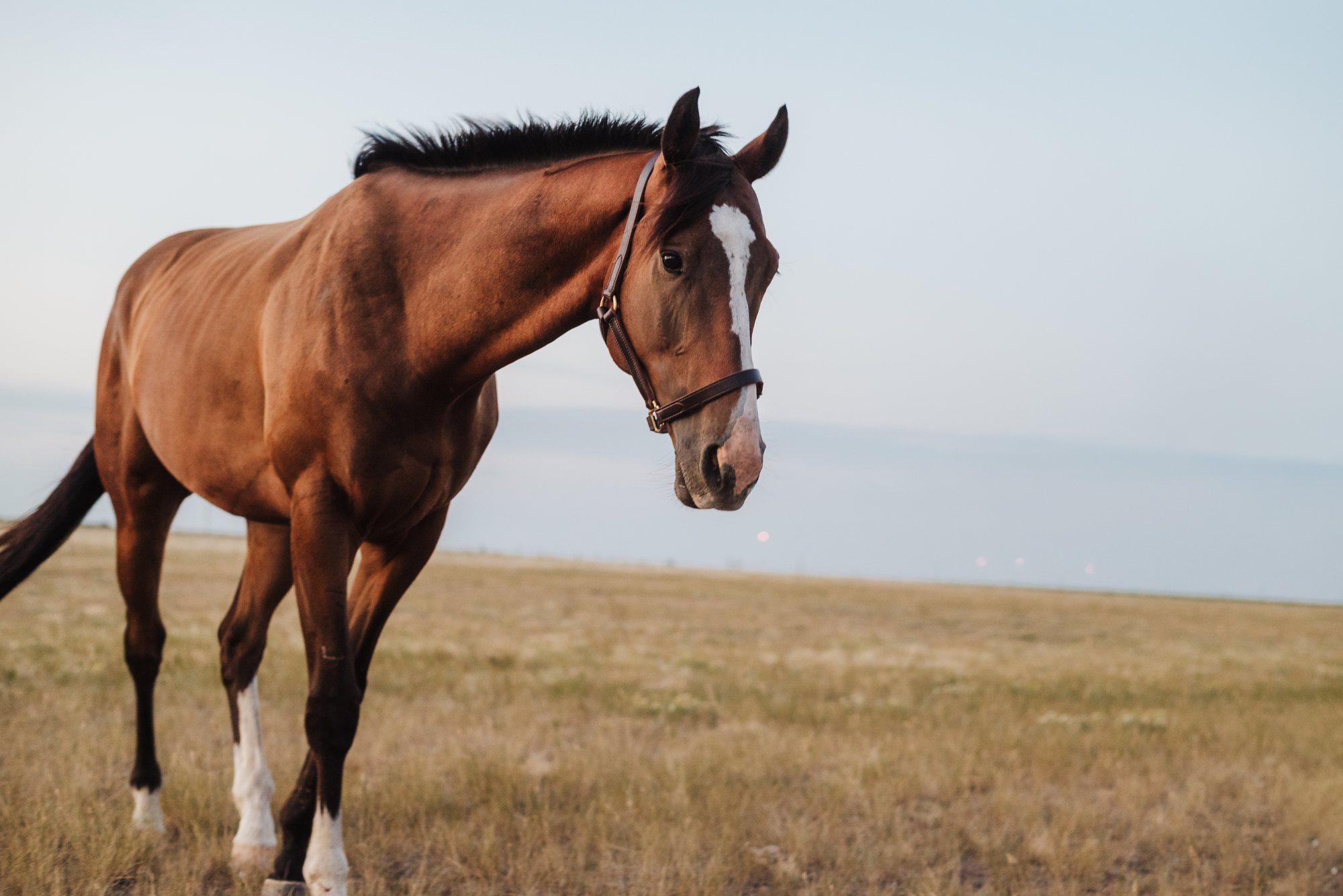
This is Harvey.
Registered as World Chaos. By Into Mischief, out of Harvestfortheworld. Seven starts, no wins, $18,581. And a stomach full of ulcers nobody wrote down.
Where the record stops
Registered as World Chaos. By Into Mischief, out of Harvestfortheworld. Seven starts, no wins, $18,581. And a stomach full of ulcers nobody wrote down.
You can look him up. That's the first thing worth saying, because I used to assume off-track horses arrived as mysteries. Harvey didn't. He came with a registered name, a foaling date of April 28, 2021, a microchip number, a Jockey Club pedigree going back generations, and a race record any stranger can pull up in thirty seconds.
His sire is Into Mischief. Three weeks ago a colt by that same stallion sold at Saratoga for four point two million dollars. His dam, Harvestfortheworld, is an Irish-bred mare by So You Think who ran seven times and won once. Harvey also ran seven times. He never won. Eighteen thousand five hundred and eighty-one dollars in earnings, a handful of placings, and then the record simply stops.
The most commercially valuable pedigree in North America, and it bought him nothing at all.
The people who had him decided he was too nice for the racing life, and that they would rather place him somewhere good than keep running him. So they got him out. He went to a broker in Virginia. At the end of January, my mother bought him for us. I say that out loud every time I talk about what he cost, because leaving it out would make everything else I say about money dishonest.
He vetted clean. Good pre-purchase exam, no injuries, nothing on the flexions.
But he was sensitive over his back. He was reactive to the girth. And he was getting harder to ride, in a way I kept explaining away, because a horse registered as World Chaos, by a stallion named Into Mischief, hands you a very convenient story. He was just being himself, I thought. He was living up to his name. Chaotic.
He was not. He was hurting.
We had already looked for the obvious things. Before he was ever ours we ran a Lyme panel, and it came back negative. We x-rayed his back for kissing spine, and the films were clean. Both are the kind of result you are relieved to get and then unsettled by, because ruling something out is not the same as finding the answer. It only tells you the problem is still there and still has no name.
We bought him anyway. Everything we knew how to test for said he was fine.
In February we scoped him. Grade 3 squamous ulcers. Ulceration across the greater curvature of his stomach, hyperkeratosis around the lesser curvature, more of it at the pylorus. Not a subtle finding. Not a recent one, either. Nothing about that stomach happened in the three weeks I'd owned him.
Three gastroscopies between February and June. Omeprazole, sixty-odd tubes of it by my count, at somewhere near fifty dollars a tube. Sucralfate twice a day for months. Misoprostol. One gut supplement swapped for another when the first one plainly wasn't working. On the third scope his stomach was called "much improved," which is the nicest sentence anyone said to me all spring.
By the time he shipped to Colorado in July, we had a written protocol for the trailer ride itself: start the omeprazole three days before loading, keep it going ten days after he landed, double the sucralfate throughout. That is what it takes to move a horse whose stomach has already been through it once.
I keep every page of it. Not because I am tidy. Because his last owners could not tell me when this started, and I refuse to hand the next person the same shrug.
How fast was he? I genuinely don't know. Seven starts and nothing to show, from a horse bred to be worth a great deal of money. By the time anyone looked inside him, his stomach was a Grade 3. Maybe he was slow. Plenty of well-bred horses are just slow.
But nobody can tell me whether he was running on that stomach, because nobody wrote it down. His pedigree goes back nine generations. The one fact that would explain his entire career is missing.
His papers are immaculate. They just don't cover the part that mattered.
He's five. He's bay, with a star, a strip, a snip, a white lip, and three socks. He is playful and genuinely brave, braver than I am most days, and I am still honestly figuring him out.
He's had ninety days of a proper restart, and now he's ridden partly by me and partly by the woman who owns our barn, twice a week, because I have a job and a daughter and there are only so many hours. He lives out on full pasture board with Marshall, which is not a compromise. It's treatment. Ulcer horses need grass and company more than they need a nice stall.
There is a version of me who wants to jump 1.30 metres. She is real and I have not retired her. I am just genuinely not sure that is where the two of us end up, and I have stopped treating that as a failure of nerve. He may do some western shows this year, which would have astonished me two years ago. What I want most is to find out what he is actually good at, rather than what his breeding said he would be.
Harvey's Journal
Ulcer management, the restart, and what a well-bred horse actually costs, in the letter every other Sunday.