OTTB · 8 min read
The Muscle Comes Last
Harvey is finally well enough to be asked for something. I have twelve weeks planned, eight poles, a round pen, and not one hill on the place. Here is the whole thing, written down before I know whether it works.
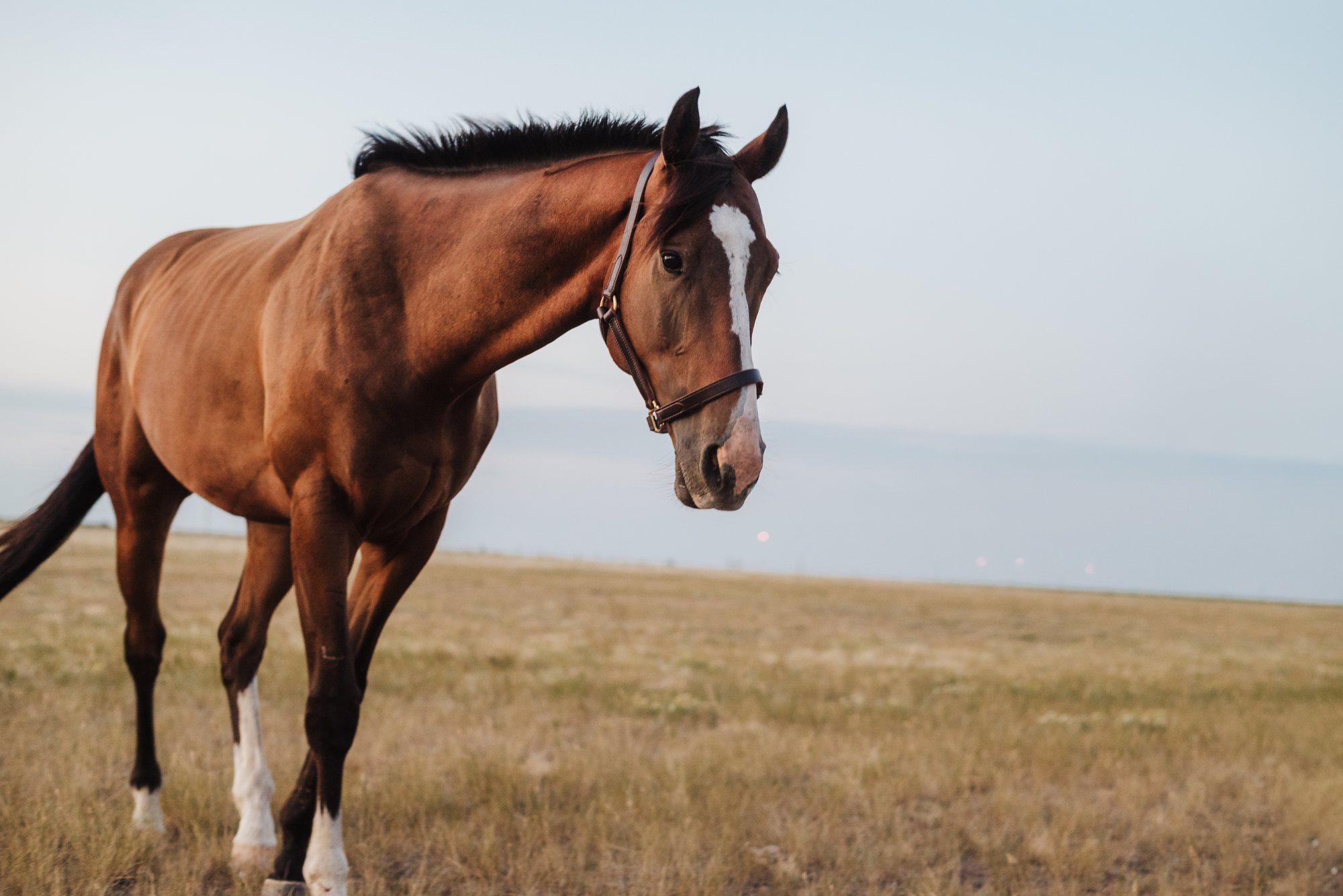
For most of the time I have owned Harvey, the honest answer to "what are you working on with him" has been "getting him comfortable enough to work on anything."
He came off the track with seven starts and no wins, and he came to us with a stomach that was already hurting. Grade three squamous ulcers, scoped three times, treated properly and at length. The last scope read much improved, with some mild irritation left over. He is on a gut supplement, he lives out on pasture with Marshall, and he eats before he works.
Which means this autumn is the first time I have been able to ask a real question of him. Not a training question. A physical one. What kind of body does this horse actually want to have, and how do I help him build it?
I had a twelve week plan drawn up for exactly that. Then I had it picked apart, rewrote it twice, and found that most of what I got wrong had nothing to do with exercises.
Every plan assumes a hill
Read any conditioning program written for an off-track Thoroughbred and you will find hills at the centre of it. Walk up, trot up, repeat. It is the single most efficient way to load the hindquarters without loading the front end, and it is free.
My property is flat. Not gently rolling. Flat. There is not a hill on it, and there is not one within any distance that makes sense to haul to three times a week.
That one fact rewrote the entire conditioning day, and it is the reason I am writing this post at all. Nobody publishes the version of the plan for people who do not have the terrain.
What went in instead: raised poles as the primary strength session, rein-back over ground poles, a great many more transitions than feel necessary, and canter intervals. What I specifically did not do is put him in deep footing, which gets suggested constantly as a hill substitute. Deep going loads the suspensory apparatus in a way that a hill does not. It is a soundness gamble dressed up as conditioning, and on a five year old Thoroughbred it is not a gamble I am taking.
Nobody publishes the version of the plan for people who do not have the terrain.
Eight poles is enough, and one thing is not
When I started this I owned no poles at all. I now own eight, at eight feet each.
Eight is genuinely enough. It builds every line, fan, serpentine and lane the plan asks for. The one exercise eight-foot poles will not properly build is the pole box square, which has to be assembled with overlapped corners and then kept strictly at the walk. That is a real limitation and I would rather say so than pretend the kit is complete.
I also have a round pen, which turned out to matter more than I expected. Some of the most useful sessions in the plan are the ones where I am not on him at all and can simply watch how he is moving that day.
The thing I actually got wrong: he has two riders
Harvey is ridden five to six times a week. Three of those rides are mine. The other two or three come from the barn owner, who gets on him while I am at a desk being useful to somebody else.
When I first wrote this plan down, I budgeted his week as though I were the only person getting on him. That is the single biggest error in the original draft, and it was not a small one. A horse doing my three careful rides is doing a completely different job from a horse doing my three plus somebody else's three, and if you build a progression on the first number while the second number is what is happening, you will overcook him and call it bad luck.
So the plan now counts work in points, across both riders, with every session scored by how hard it actually is. There is a weekly total to stay inside and a ceiling on ridden minutes. It is fussier than I would like. It is also the only way the arithmetic is honest.
The corollary took me longer to accept: a deload week is not a deload if only one of his two riders knows it is happening. Easing off my own rides while his other three stay the same does nothing except make me feel organised. That conversation has to be had out loud, so the plan includes what to actually say.
There is an unexpected gift in the arrangement, though. Two riders is a diagnostic. If a problem turns up for both of us, it is the horse and it wants a vet or a saddle fitter. If it turns up for only one of us, it is the rider. I have never had that instrument before and it is worth more than any exercise on the list.
Week zero, which is not training
The first week of the plan contains no conditioning at all.
It is a gate. Saddle fit checked on the body he has now rather than the body he had in the spring. A conversation with the farrier and the vet about how he is actually landing and travelling, and whether anything in that warrants a closer look. Somewhere to write down what he looks like at the start, because in twelve weeks I will not remember accurately and I will want to compare.
None of that is exciting and all of it is the part people skip. Conditioning a horse whose saddle does not fit is just applying load to a problem.
The order matters more than the exercises
Two sequencing decisions were wrong in my first draft and are worth naming, because I do not think they are obvious.
Shoulder-fore comes before leg-yield. Harvey drifts out through his outside shoulder. Leg-yield asks a horse to move sideways off the leg, and a horse who is already escaping through that shoulder will happily use leg-yield to practise escaping through that shoulder. Shoulder-fore addresses the drift first. Then the lateral work has something to sit on.
The canter comes early, not late. My original plan held canter work back until week ten, which is standard advice for bringing a horse into work. It is the wrong advice for this horse. The canter is the most established gait an ex-racehorse owns. It is the thing he has done thousands of times, correctly, under professionals. Treating it as the advanced module at the end is treating a Thoroughbred like a green horse, and it wastes the one piece of fitness he came with.
What I expect to see, and when
Here is the part I most want somebody to have told me at the beginning.
Condition responds in about four to eight weeks. If the feeding is right and the work is right, he will look better in two months in the way that a horse looks better when he is carrying appropriate weight.
Muscle is three to six months. Topline, real hindquarter development, the shape that makes people ask what you have been doing with him. That is not a twelve week outcome. It cannot be.
So twelve weeks is not enough time to build this horse a body. Twelve weeks is enough time to prove that the work is being done correctly, that he is staying sound and comfortable while doing it, and that the plan deserves the next twelve weeks. That is the actual goal, and setting it correctly is most of what stops people quitting a program in week seven because their horse does not look like the internet yet.
The other honest note: his feeding is already sound. I had it looked over properly and the bucket is not the problem. The open question is how much hay he is really eating out on pasture, which is a harder thing to measure and a duller thing to write about, and probably matters more than any single exercise below it.
Why I am publishing this now
Because I have not done it yet.
It would be much easier to run the twelve weeks, see how it went, and then write the version where I knew what I was doing the whole time. That version is more flattering and considerably less useful. Every conditioning article I read while building this was written by somebody standing at the finish, and not one of them told me what to do about the hills I do not have.
So this is the plan, before the fact. I will write what happens, including if what happens is that it did not work and I had to change it. He is five, he is sound, he is finally comfortable, and I would like to find out what he is capable of when somebody builds him carefully.
Morgan
The polework, free
Ten pole exercises and five round pen exercises, all of them built for eight poles and flat ground, each with a diagram. It is the strength half of this plan, written so you can measure it to your own horse. Get The Pole Playbook →
Keep reading
Harvey, and where the record stops
You Can't Just Pull the Shoes Off a Thoroughbred